AI for tender analysis: what it actually does (and what it doesn't)
A typical tender document runs 180–250 pages. Somewhere in those pages are the five or six details that determine whether submitting a bid is worth your team's time. Most procurement teams read the whole thing anyway — ...

A typical tender for a regional infrastructure project runs 180–250 pages. It includes a notice, a specification document, administrative requirements, technical requirements, scoring criteria, exclusion clauses, and a documentation checklist that references forms which are themselves 20 pages each. Somewhere in those pages are the five or six details that determine whether submitting a bid is worth your team's time: the minimum turnover threshold, the qualification requirements, the weighting between price and technical score, the key deadline dates, and whether the scope actually matches what you do.
Most procurement teams read the whole thing anyway — because missing a disqualifying clause late in the process is worse than never bidding. That sequential read-to-qualify workflow is where AI removes the most time, without removing the human judgement that determines whether to bid.
What the analysis workflow actually looks like
The manual workflow for a mid-complexity tender typically breaks down like this: one person reads the full bando and capitolato (half a day minimum), extracts the qualification thresholds and scoring criteria into a spreadsheet, and flags ambiguities for discussion. A second person checks the documentation checklist against your company's existing certifications. Someone else maps the technical requirements against your capabilities. A bid/no-bid decision gets made — often two days after the tender was first identified — and if the answer is yes, writing begins with deadline pressure already building.
The inefficiency isn't in the reading itself. It's in the extraction: pulling structured information (dates, numbers, criteria weights, required certifications) from unstructured prose spread across a 200-page document, accurately, under time pressure, every time a new tender comes in.
What AI actually does here
An AI system applied to tender analysis doesn't replace the bid/no-bid judgement or the bid writing. It handles the extraction layer — the part that consumes analyst time without requiring analyst expertise.
In practice: you upload the tender documents to a system built around a large language model. The model reads the full document set and produces a structured output — eligibility criteria with the specific thresholds, scoring breakdown with criteria and weights, documentation checklist with what's required and in what form, key dates, and a summary of any clauses that are ambiguous or unusual. A bid/no-bid input document that would take half a day to produce manually comes out in 10–15 minutes.
The analyst's time shifts from extraction to decision-making: is the turnover threshold actually a problem for us? Does our technical profile score well under these weights? Are the ambiguous clauses worth a pre-tender clarification request? That's a different kind of work — and a more valuable one.
The Italian procurement context
Italian public procurement has specific characteristics that affect how AI tools need to be configured. The Codice dei Contratti Pubblici (D.Lgs. 36/2023) introduced significant structural changes to how bids are structured and evaluated. ANAC's portals — including the Banca Dati Nazionale dei Contratti Pubblici — publish documentation in standardised formats that AI systems can be trained to parse reliably.
For Italian companies that bid regularly on public contracts, the volume of tender documentation is substantial: hundreds of bandi per year across the relevant CPV codes, the majority of which don't warrant full analysis. AI-assisted pre-screening — reading the summary fields and eligibility thresholds before a human commits time to the full document — is where the time savings are most pronounced. You eliminate the 30-minute preliminary reads on tenders that should have been disqualified in five.
The combination of a Claude Project loaded with your company's qualification documents (SOA certifications, financial statements, past contracts, technical CV) and a tender analysis workflow gives you something more useful than speed alone: you can ask Claude to cross-reference the tender's eligibility requirements directly against your documentation and tell you where you qualify, where you're borderline, and what's missing. The analysis becomes specific to your situation, not generic.
What AI doesn't solve
Tender analysis AI handles extraction well. It handles document comparison reasonably well — comparing this tender's requirements against a previous one, or against your standard capability statement. It doesn't reliably handle interpretation of ambiguous regulatory references, or competitive positioning judgements that depend on market knowledge the model doesn't have.
The risk to watch for: treating AI-extracted data as final without human review. Extraction errors in tender analysis — a misread percentage, a missed exclusion clause — are costly. The right architecture builds in a review step: the AI produces the structured extract, an analyst spot-checks the high-stakes fields (qualification thresholds, exclusion grounds, scoring weights), and the output becomes the basis for the bid decision. Not a replacement for it.
Speed without accuracy isn't useful in procurement. The goal is to reach the decision point faster with better information — not to remove human judgement from a process where errors have real consequences.
Working through high volumes of tender documents?
We build AI-assisted tender analysis systems for procurement teams — configured around your document types, integrated with your qualification data, and designed with a human review step built in. If you're evaluating whether this makes sense for your team, a scoping conversation is the right starting point.
Let's talk about your procurement workflow →
Drawing from over 20 years of expertise as Fractional innovation Manager, I love bridging diverse knowledge areas while fostering seamless collaboration among internal departments, external agencies, and providers. My approach is characterized by a collaborative and engaging management style, strong negotiation skills, and a clear vision to preemptively address operational risks.
No guesswork.
No slide decks.
Just impact.
Ready to move from AI hype to a working system? In a free 30-minute call we'll identify your highest-impact use case and tell you exactly what it takes to get there.
No upfront cost · Italy · Malta · Europe · English & Italian
Competitive intelligence has a freshness problem. A thorough manual analysis of three or four competitors takes two to four days to produce ...
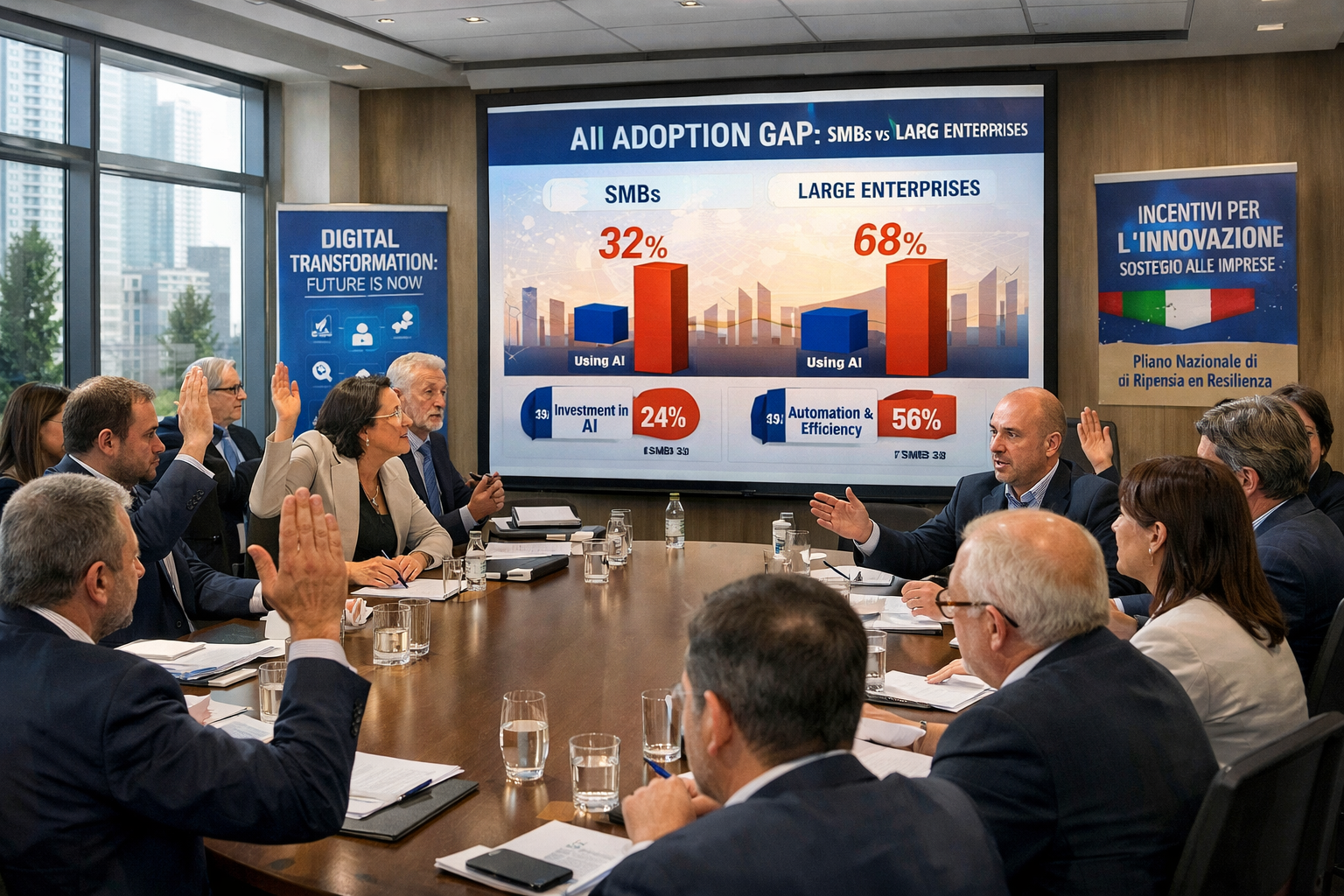
Italy's AI market grew 58% in 2024. The share of Italian SMBs that have actually started an AI project sits at 15% for mid-sized companies ...
Due diligence is fundamentally a document problem. A typical M&A or investment process generates hundreds of documents spread across a ...