AI lead scoring: what it's actually doing when it qualifies your pipeline
The real problem with manual lead qualification isn't the time it takes — it's the inconsistency. Two reps looking at the same prospect often reach different conclusions, because they're weighting different signals ...

The real problem with manual lead qualification isn't the time it takes. It's the inconsistency. Two sales reps looking at the same prospect often reach different conclusions, because they're weighting different signals, drawing on different experiences, and working under different levels of deadline pressure. Scale that inconsistency across a team and a pipeline of hundreds of contacts, and you lose the ability to make reliable prioritisation decisions.
AI lead scoring addresses the consistency problem first, and the speed problem as a consequence. Understanding that distinction matters for setting the right expectations about what you're building.
What lead scoring actually involves
A lead score is a composite signal — a number or category that summarises how likely a given contact or company is to become a customer, and how valuable they'd be if they did. It draws on two distinct types of data that are worth keeping separate.
Fit is about whether this company matches your ideal customer profile: industry, size, geography, revenue range, technology stack, organisational structure. A company can score perfectly on fit and still never buy — because they're not actively looking, they have no budget right now, or there's an incumbent relationship they're not going to disrupt.
Intent is about whether this company is showing signals of active interest: recent web behaviour, content downloads, attendance at relevant events, job postings that indicate a relevant initiative, funding rounds that typically precede purchasing decisions in your category. Intent data tells you fit at a moment in time, not just in the abstract.
Manual scoring tends to collapse these two dimensions or conflate them. AI scoring can maintain them as separate dimensions and weight them differently depending on your sales motion — which matters when your decision about whether to call someone today should be driven by intent, not just by fit.
What AI is doing when it scores
An AI lead scoring system is doing three things at once that are impractical to do manually at scale.
First, data aggregation. For each company in your pipeline, the system pulls signals from multiple sources: CRM data, website behaviour, company databases (Clearbit, Apollo, LinkedIn data), technographic sources that identify what software the company uses, and intent data providers that track third-party buying signals. A human researcher could do this for one company in 30–45 minutes. The AI does it for 500 companies overnight.
Second, ICP matching. Once you've defined your ideal customer profile — the specific firmographic and technographic characteristics that correlate with your best customers — the system scores every prospect against those criteria consistently. No rep is underweighting the criteria they find less intuitive or overweighting the ones that remind them of a recent win.
Third, signal surfacing. Good AI scoring doesn't just produce a number — it shows you which signals drove the score, so your rep opens the call knowing that this company recently hired a Head of Digital Transformation and switched from a legacy ERP to SAP. That context is more useful than a score of 87.
What the architecture looks like in practice
A practical implementation for a B2B sales team typically combines three components. A data enrichment layer that pulls firmographic and technographic data on incoming leads automatically, reducing the manual research burden on reps. A scoring model trained on your historical closed-won and closed-lost deals — so the ICP criteria reflect what actually predicts conversion in your market, not a generic template. And a CRM integration that surfaces scores and signals in the rep's existing workflow rather than requiring them to log into a separate tool.
The scoring model needs periodic retraining as your customer base evolves and your market shifts. A model trained on 2022 won deals may not weight the right signals in 2026 if your ICP has moved. This is maintenance work that's easy to underestimate when evaluating the investment.
What AI scoring doesn't replace
Two things that remain human, and where trying to automate them creates problems.
Relationship intelligence. The score doesn't know that your rep spoke to this company's procurement head at an event last month, or that a former customer just moved there. Signals that live in your team's heads and conversation history don't aggregate into a model automatically — they require deliberate capture to become useful inputs.
Buying committee dynamics. A company can be a perfect ICP fit with strong intent signals and still be a difficult deal because the actual buying decision involves five people with conflicting priorities. AI scoring tells you where to focus attention. It doesn't tell you how hard the deal will be once you get in the room.
The useful mental model: AI scoring tells your team where to look. It doesn't tell them what they'll find when they get there.
Pipeline qualification taking too much of your team's time?
We build AI lead scoring systems configured around your ICP and historical deal data — integrated into your CRM so signals surface where your reps already work. If you're evaluating whether this fits your sales motion, a scoping conversation is the right starting point.
Let's talk about your pipeline →
Drawing from over 20 years of expertise as Fractional innovation Manager, I love bridging diverse knowledge areas while fostering seamless collaboration among internal departments, external agencies, and providers. My approach is characterized by a collaborative and engaging management style, strong negotiation skills, and a clear vision to preemptively address operational risks.
No guesswork.
No slide decks.
Just impact.
Ready to move from AI hype to a working system? In a free 30-minute call we'll identify your highest-impact use case and tell you exactly what it takes to get there.
No upfront cost · Italy · Malta · Europe · English & Italian
In February 2024, a Canadian tribunal ruled that Air Canada was liable for incorrect information its chatbot had given a passenger — ...
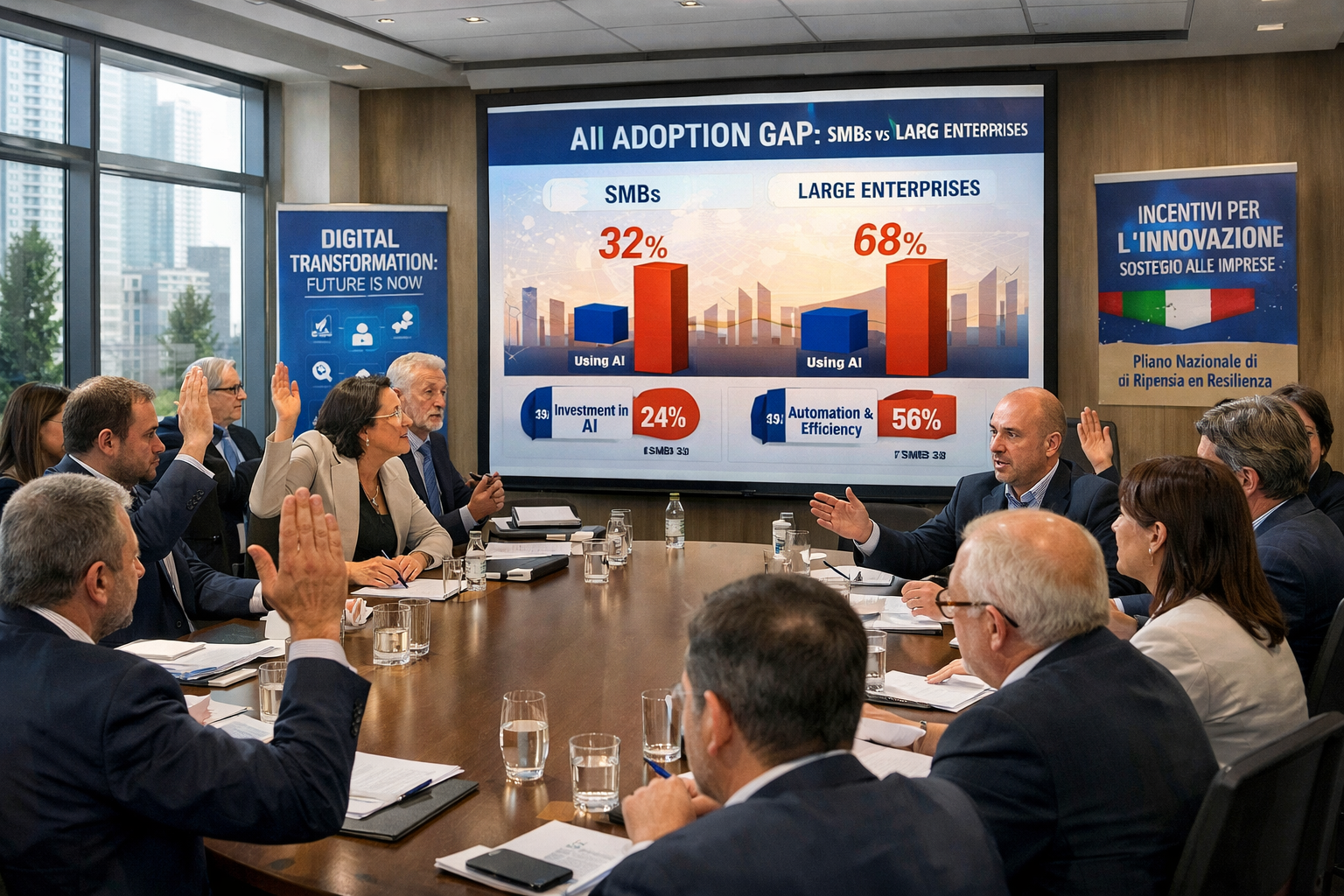
Italy's AI market grew 58% in 2024. The share of Italian SMBs that have actually started an AI project sits at 15% for mid-sized companies ...

The EU AI Act is already in force. Italian Law 132/2025 is live. GDPR now explicitly covers automated decisions. If you deploy AI in your ...