From Normattiva to Claude: A real AI use case for Italian Legal and Compliance Teams
If you haven't read our intro on MCP Servers yet, start there — it covers the full picture of where Agentic AI delivers the highest ROI, when connected to external data sources in real-time.
If you haven't read our intro on MCP Servers yet, start there — it covers the full picture of where Agentic AI delivers the highest ROI, when connected to external data sources in real-time.
The Italian compliance problem nobody talks about
If you run a business in Italy — or advise one — you're familiar with Normattiva. It's the official portal managed by the Istituto Poligrafico e Zecca dello Stato that consolidates Italy's entire legislative database: laws, legislative decrees, ministerial decrees, and every update published in the Gazzetta Ufficiale.
It's a genuinely impressive public resource. And it's also, for anyone who uses it regularly, a time sink.
The typical workflow looks like this: you go to normattiva.it, run a keyword search, download the relevant act as a PDF, open your internal documents — contracts, compliance policies, audit reports — and manually cross-reference the two. If the legislation has been updated recently (in Q1 2024 alone, over 250 acts were modified, including 49 laws), you go back, search again, download again, cross-reference again.
This isn't a workflow. It's busywork that happens to require a law degree.
Who actually does this work — and how much of their time it takes
The people spending hours on this are not junior staff. In most Italian companies and professional firms, this work falls on:
- Legal counsel and in-house lawyers — tracking regulatory changes, verifying compliance obligations, updating contract templates
- Compliance officers — monitoring updates across multiple regulatory frameworks (GDPR, D.Lgs. 231/2001, workplace safety, environmental law)
- HR managers — checking labour law updates against internal policies and collective agreements (CCNL)
- Accountants and tax advisors — cross-referencing fiscal legislation with client situations
- Paralegals and legal assistants — doing the search-download-cross-reference cycle on behalf of the above
Conservative estimate: 3–5 hours per week per person on this category of work. In a team of four, that's 600–1,000 hours per year — on tasks that add zero strategic value, only operational necessity.
The AI research benchmark for legal work puts the improvement potential at 40–55% for research and document review cycles. That potential assumes you've actually connected the tools. Most teams haven't.
What a connected solution looks like
Here's the setup — straightforward to replicate today.
You create a Claude Project where you upload your working documents: contracts under review, your compliance policy library, past due diligence reports, CCNL agreements, internal regulatory memos. Claude indexes all of it and keeps it in context across every conversation in that project.
Then you add one extension: the Normattiva MCP — a Claude Desktop extension that connects Claude directly to Normattiva's official OpenData API.
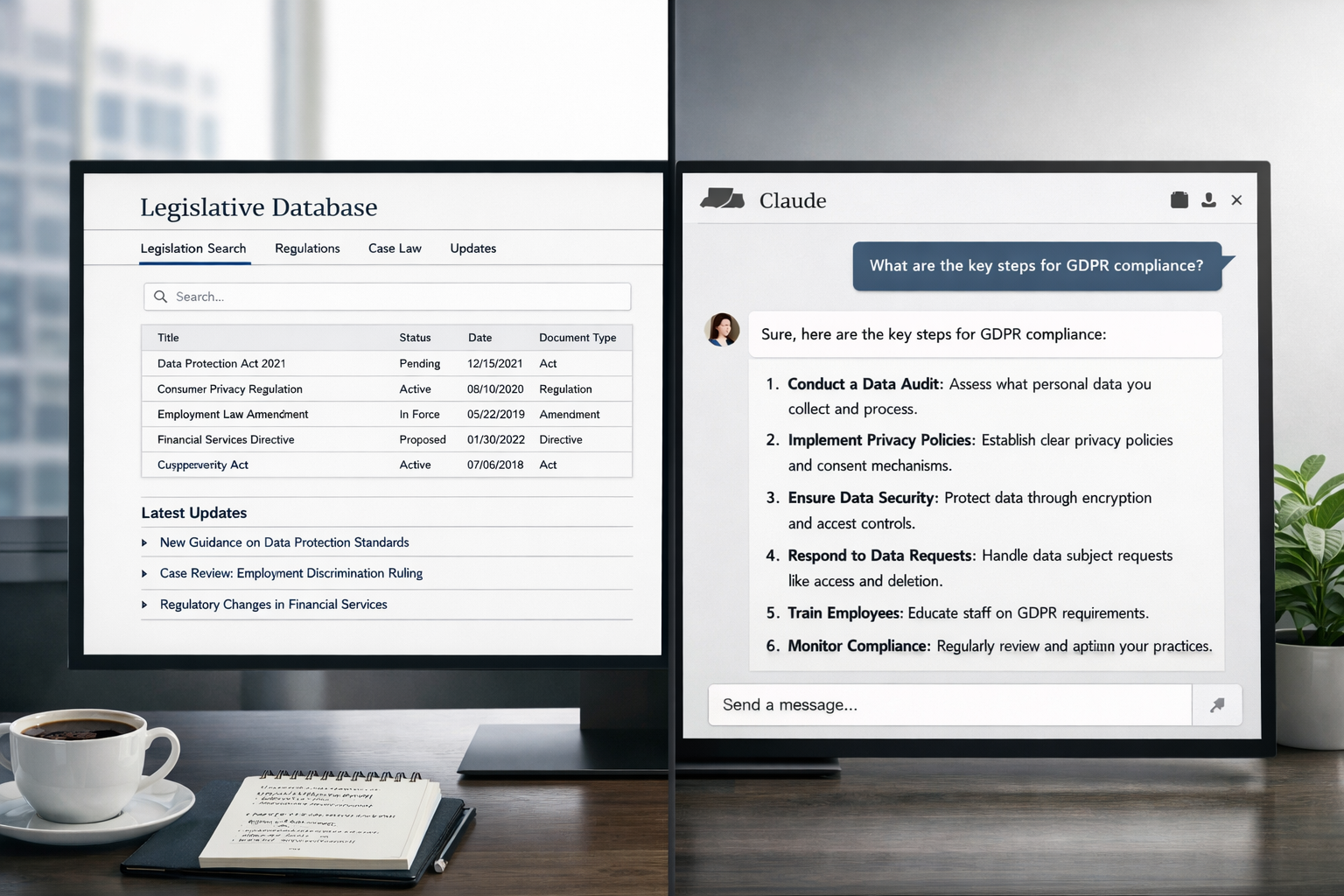
Inside a single conversation you can now ask Claude to pull the current text of any Italian law or decree from the official source, cross-reference it against your internal documents in the same prompt, and reason across both simultaneously.
No switching tabs.
No downloading PDFs.
No manual cross-referencing.
What this actually enables — three concrete scenarios
The most useful way to describe what the extension does is to show it. Here are three workflows we ran while building this — each one a real legal or compliance problem, each one solvable in a single Claude conversation.
"My client was dismissed in February 2021. Under which version of Article 18 do we evaluate the case?"
This question comes up constantly in employment litigation. Italian employment law has been modified repeatedly — the 2012 Fornero reform, then two Constitutional Court rulings in 2021 and 2022. The 2021 ruling (C. Cost. n. 59, April 2021) changed reinstatement for unfounded objective dismissal from discretionary to mandatory. The 2022 ruling (C. Cost. n. 125, May 2022) removed the word "manifesta" from the threshold, broadening the scope further.
For a dismissal dated February 2021, this matters enormously: the 2021 ruling came two months after the dismissal. Using the extension, we retrieved Article 18 of L. 300/1970 directly from Normattiva — not just the current text, but the complete embedded update trail with dates.
Claude read the sequence of modifications, identified which version was in force on the date of the dismissal, and answered which regime applies — without the lawyer navigating versioni storiche on normattiva.it or pulling archived PDFs. The API also supports direct historical retrieval by specifying a precise date.
"Has the legislation our D.Lgs. 231 Organizational Model is based on changed since we last revised it?"
Every Italian company of meaningful size maintains an Organizational Model under D.Lgs. 231/2001 (corporate criminal liability). These models need to be kept current: each time a new predicate offence is added or procedural rules change, the model needs reviewing. In practice, most companies revise their MOG reactively — after an audit or a legal incident — rather than proactively.
The workflow: upload the company's MOG into the Claude Project, then retrieve the current text of D.Lgs. 231/2001 via the extension. The retrieved document includes the complete legislative history embedded within it — every modification since 2001, with dates. Claude compares the model's last revision date against the modification history, identifies which articles changed after that date, and produces a targeted gap analysis. What used to require a compliance lawyer spending a day cross-referencing is now a 10-minute conversation — against the authoritative, up-to-date source, not a cached PDF from 18 months ago.
"We have a new food-sector client. Which food safety regulations are currently in force, and what changed recently?"
We ran a full-text search for "sicurezza alimentare igiene alimenti" across all currently-in-force acts. The extension returned 108 results across 14 pages — with structured facets breaking down the results by type (39 laws, 28 decree-laws, 28 legislative decrees) and by issuing authority, including acts directly from the Ministry of Health. That breakdown is not something normattiva.it surfaces in a usable format from a standard search.
The practical workflow: the food-sector client uploads their internal HACCP procedures into the Claude Project. In the same conversation, Claude runs the regulatory search, identifies the in-force acts most relevant to their operations, checks which were modified in the past 12 months, and cross-references against the uploaded procedures — flagging specific clauses that may need updating. The value is in the combination: regulatory search through the extension, internal document knowledge from the project, and Claude reasoning across both in the same context.
The RAAS Impact Normattiva Extension
The extension we used throughout this post is open source and published under the RAAS Impact GitHub organisation:
👉 github.com/RAAS-Impact/normattiva-claude-mcb
Installation takes one step:
- Download the
.mcpbfile from the latest release - Drag it into Claude Desktop → Settings → Extensions
No terminal, no configuration, no Node.js setup required — Claude Desktop bundles everything it needs.
Under the hood, it implements the full Normattiva OpenData REST API as MCP tools: free-text search, advanced filtered search, full act retrieval by code or URN, update tracking by date range, and a four-step async bulk export workflow for larger data sets. It's a single JavaScript file with no external dependencies.
The repository also includes a SKILL.md file — a set of instructions you paste directly into your Claude Project to teach Claude how to navigate the Normattiva API correctly: which tool to call, in what order, and how to handle edge cases like acts that exceed the 7,000-document export limit.
This is one example of a repeatable pattern
What we've described here — a Claude Project combining internal document knowledge with a live external data source through an MCP extension — is not a one-off trick. It's a pattern that works wherever your team manually switches between an authoritative external database and their own documents.
Normattiva is a clean example because the data source is public, well-documented, and directly relevant to a high-friction daily workflow for a large number of Italian professionals. But the underlying approach applies anywhere that pattern exists: your team queries an external source, downloads something, opens their own documents, and cross-references. That's the friction AI can eliminate — not by replacing expertise, but by removing the plumbing that surrounds it.
The Normattiva MCP extension is open source and free to use. RAAS Impact built it to demonstrate what's possible — and because we believe the best way to explain AI implementation is to build something real and show it working.

Drawing from over 20 years of expertise as Fractional innovation Manager, I love bridging diverse knowledge areas while fostering seamless collaboration among internal departments, external agencies, and providers. My approach is characterized by a collaborative and engaging management style, strong negotiation skills, and a clear vision to preemptively address operational risks.
No guesswork.
No slide decks.
Just impact.
Ready to move from AI hype to a working system? In a free 30-minute call we'll identify your highest-impact use case and tell you exactly what it takes to get there.
No upfront cost · Italy · Malta · Europe · English & Italian
Small Language Models: Privacy, Cost and GDPR Compliance for European Businesses A few months ago, an Italian manufacturing company asked ...

Due diligence is fundamentally a document problem. A typical M&A or investment process generates hundreds of documents spread across a ...
The complete implementation guide: building the ADK agent, handling tool calls, and what happens when an LLM meets real ERP complexity.