AI adoption in Italian SMBs: what the data actually shows
Italy's AI market grew 58% in 2024. The share of Italian SMBs that have actually started an AI project sits at 15% for mid-sized companies and 7% for smaller ones — against more than 50% for large enterprises. That gap ...
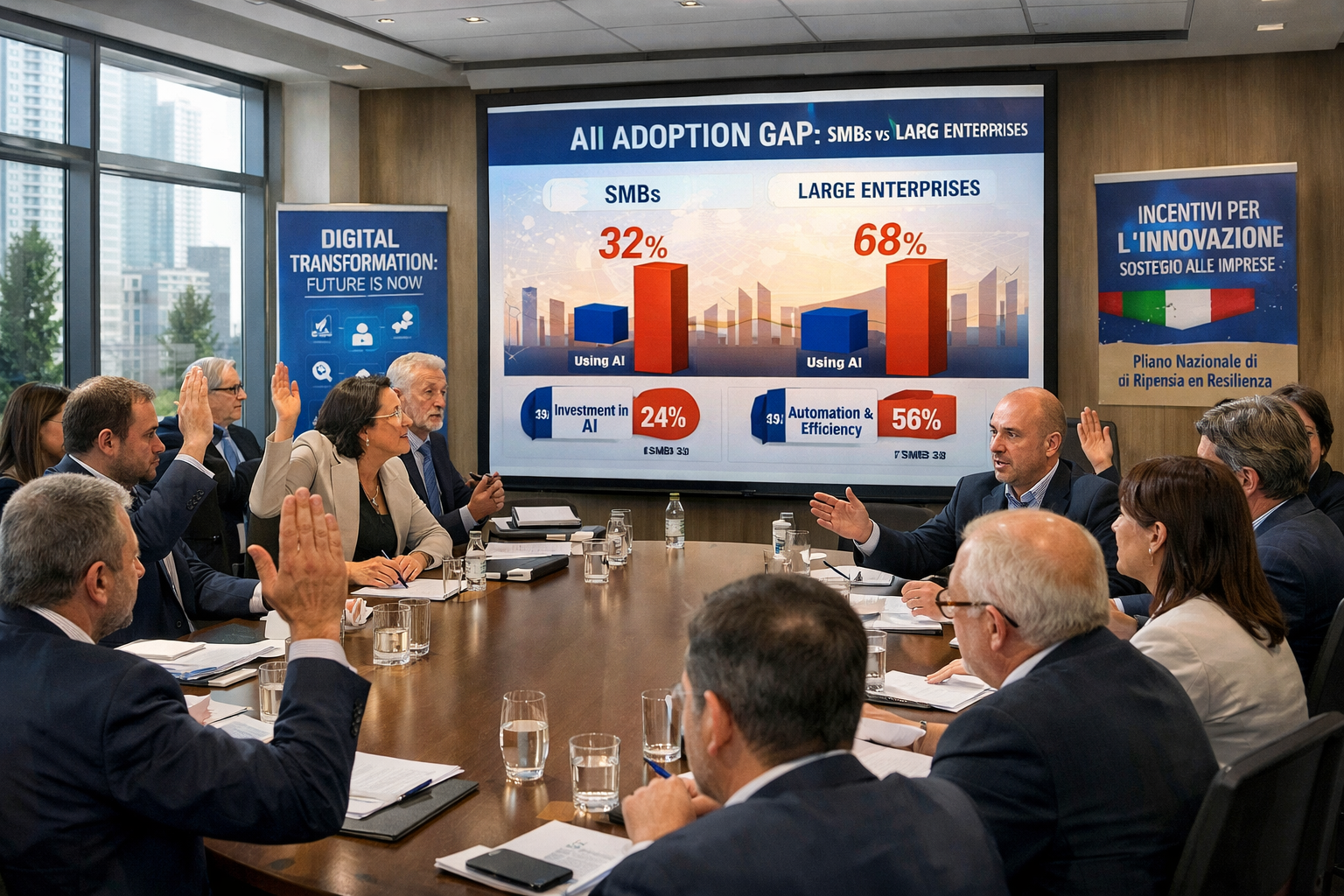
Italy's AI market grew 58% in 2024, reaching €1.2 billion. The share of Italian SMBs that have actually started an AI project sits at 15% for mid-sized companies and 7% for smaller ones — against more than 50% for large enterprises.
That gap isn't explained by scepticism. In the same surveys, 84% of Italian business leaders agree AI positively impacts productivity. Most Italian executives understand what AI can do. Far fewer have worked out how to get started under their specific constraints.
This post is about what those constraints actually are — based on the data, not the general narrative — and what distinguishes the Italian SMBs that have crossed from evaluation to deployment.
The actual adoption numbers
Italy ranks third in Europe for overall AI adoption at 77%, behind Spain and Switzerland. That headline figure masks a more divided picture. Only 29.7% of Italian SMBs are engaged in any AI-related initiative — and "engaged" includes exploration and planning stages. Actual deployment is far lower.
The potential is real: the estimated added value for SMBs alone is up to €122 billion. The Italian AI market is growing fast. But large enterprises capture the disproportionate share of that growth. SMBs — which represent 99% of Italian businesses and employ 78% of the private-sector workforce — are largely on the sidelines of their own market's AI transformation.
This is the paradox worth sitting with: not that Italian SMB leaders don't believe in AI, but that belief and implementation are disconnected. Understanding the reasons for that gap is more useful than lamenting it.
Three barriers that actually explain the gap
Skills. 49% of Italian SMB leaders cite lack of knowledge as the primary adoption barrier. Italy faces a structural deficit of 3.7 million employees with basic digital skills. Only 54% of Italian managers report confidence in AI training and readiness — below Switzerland at 72% and Belgium at 56%. This isn't only a hiring problem. It's a decision-making problem: executives who don't understand AI well enough to evaluate solutions can't commit to implementations they can't assess. The skills gap affects both execution and judgement.
ROI clarity. Companies that have deployed AI report strong results — average productivity increases of 32%, time savings of 40% on manual tasks, revenue increases of up to 34% in strong cases. But these numbers don't help an executive who hasn't deployed yet. AI ROI is hard to estimate before implementation: the gains are real but the path from "evaluating" to "measuring results" requires upfront investment and internal capability that many SMBs haven't built. Add potential compliance costs for high-risk AI systems under the EU AI Act and the business case becomes genuinely difficult to construct without specialist input.
Regulatory complexity. 80% of Italian business leaders report not fully understanding their EU AI Act obligations. The Italian regulatory environment — GDPR enforcement from one of Europe's most active data protection authorities, combined with the new AI Act framework — creates compliance risk that rational executives are right to factor in. The Garante's actions against ChatGPT and DeepSeek have made this concrete rather than theoretical. Regulated sectors — healthcare, financial services, HR, legal — face additional layer complexity that effectively raises the cost of getting it wrong.
These three barriers reinforce each other. Limited internal skills make it harder to build the ROI case. Regulatory uncertainty raises the cost of a failed experiment. Together they produce the decision paralysis that shows up in the data: companies that understand the opportunity but don't act on it.
What successful adopters do differently
The Italian SMBs that have moved from evaluation to deployment share a recognisable set of patterns — not unique to AI, but applied consistently.
They start narrow. Rather than attempting broad AI transformation, successful implementors identify one high-friction workflow — tender document analysis, invoice processing, customer support triage, regulatory monitoring — and deploy there first. The scope is small enough to manage, specific enough to measure, and valuable enough to justify the internal effort. This is how you build the ROI case from evidence rather than projections.
They treat compliance as a design input, not an afterthought. Companies that run into problems with AI deployments usually moved fast and added compliance considerations late. Companies that structure their AI architecture around GDPR and AI Act requirements from the start — data residency, access controls, human oversight mechanisms — move slower initially and faster sustainably. For Italian businesses specifically, where the Garante's enforcement record is visible and recent, this isn't overcaution.
They invest in internal understanding before tool selection. The 73% of successful Italian companies that actively invite employees to use AI tools, and the 57% that provide formal AI training, aren't doing this for cultural reasons alone. Internal capability is what lets an organisation evaluate whether an AI solution actually fits its workflow — and adapt it when requirements change. Buying a tool before anyone internally can assess it produces the shelf-ware pattern: purchased, partially deployed, quietly abandoned.
They measure from the start. The Italian SMBs with strong AI ROI track records all have this in common: they defined what "working" looks like before they began. Productivity improvement, time saved per transaction, error rate reduction — a concrete metric matched to the business problem, measured before and after. This is what makes it possible to expand from a pilot to a programme.
The government support most SMBs aren't using
Italy has committed substantial public funding to SMB digital transformation: €2.5 billion specifically for AI through the National Strategic Programme, €47 billion for broader digitalisation through the PNRR, plus Industry 4.0 tax credits at 20% on capital goods investments, R&D tax credits, and regional programmes including the Nuova Sabatini zero-rate subsidised loans (€50,000–2 million) for digital technology purchases.
The problem is access. Over 600 stakeholders appear in the national digital support ecosystem. Multiple business associations run separate digital innovation hubs with different assessment frameworks. The administrative burden is real, and most Italian SMB executives — who are running businesses, not navigating grant programmes — don't have the bandwidth to map the ecosystem and identify what applies to their situation. The funding exists. The pathway to it is opaque.
A realistic starting point
The practical starting point for most Italian SMBs isn't a technology decision — it's a workflow audit. Map the knowledge-work processes that consume the most time and involve the most manual switching between information sources: regulatory research, document review, customer communications, tender preparation. These are the categories where AI delivers measurable ROI fastest and where SMBs have the most to gain relative to their current processes.
For each candidate workflow, ask two questions: how sensitive is the data involved, and how narrowly scoped is the task? High-sensitivity, narrow-scope tasks are the best fit for an initial deployment — the compliance surface is manageable and the ROI is measurable. Broad, mixed-data tasks are harder and belong later in the sequence.
The gap between Italian SMBs that are watching AI adoption happen and those driving it isn't a technology gap. It's a decision gap — between understanding the opportunity and having a concrete, bounded next step. The data on what works is clear enough. The question is whether the organisation can create the conditions to act on it.
Trying to work out where to start with AI in your organisation?
We work with Italian SMBs to identify the highest-ROI AI use cases, design implementations that fit within your compliance constraints, and build the internal capability that makes adoption sustainable. If you're at the evaluation stage and want a structured view of where to focus, a scoping conversation is the right starting point.
Let's scope your AI priorities →
Drawing from over 20 years of expertise as Fractional innovation Manager, I love bridging diverse knowledge areas while fostering seamless collaboration among internal departments, external agencies, and providers. My approach is characterized by a collaborative and engaging management style, strong negotiation skills, and a clear vision to preemptively address operational risks.
No guesswork.
No slide decks.
Just impact.
Ready to move from AI hype to a working system? In a free 30-minute call we'll identify your highest-impact use case and tell you exactly what it takes to get there.
No upfront cost · Italy · Malta · Europe · English & Italian
Every few months, a business asks us to fine-tune an AI model for their use case. Sometimes that's exactly the right call. More often, the ...

An AI customer support chatbot is only as good as the knowledge it's built on. The technology is available and mature — the challenge is ...

A typical tender document runs 180–250 pages. Somewhere in those pages are the five or six details that determine whether submitting a bid ...