AI customer support: what the chatbot handles and what it doesn't
An AI customer support chatbot is only as good as the knowledge it's built on. The technology is available and mature — the challenge is designing a system that handles what it should, escalates what it shouldn't, and ...

An AI customer support chatbot is only as good as the knowledge it's built on. This sounds obvious, but it's the point most implementations miss: the chatbot doesn't create answers, it retrieves and synthesises them from what you've already documented. If your knowledge base is thin, the bot will deflect or hallucinate. If your escalation logic is poorly designed, it will frustrate customers at exactly the moment they need help most.
Getting this right is an architectural problem, not a technology problem. The technology is available and mature. The challenge is designing a system that handles what it should handle, escalates what it shouldn't, and builds rather than erodes customer trust in the process.
What AI support handles well
The highest-value use cases for AI in customer support are all variations on the same pattern: a customer asks a question that has a knowable answer, and that answer exists somewhere in your documentation.
Product and feature questions against your documentation are the clearest case. FAQ resolution — questions that appear in your ticket history with high frequency and consistent answers — is another strong fit. Order status, account information retrieval, and basic troubleshooting flows (the kind that a tier-1 agent works through from a script) are all tractable for a well-configured AI system. The common thread: the answer is deterministic or can be found in structured data, and the customer's frustration tolerance is relatively high for a one-to-two exchange resolution.
What you get from automating these categories isn't primarily cost reduction — though containment does reduce ticket volume. It's speed. A customer who gets an accurate answer in 30 seconds at midnight has a meaningfully better experience than one who waits until 9am for a human to tell them the same thing.
What AI support doesn't handle well
Three categories where AI chatbots consistently underperform, and where the failure damages trust rather than just creating inconvenience.
Complex complaints and disputes. When a customer is frustrated, they need to feel heard before they'll accept a resolution. AI systems that respond to an angry message about a billing error with a technically accurate but tonally neutral policy explanation tend to escalate the emotional intensity of the interaction rather than de-escalate it. These conversations need a human — not because the information is beyond the AI's capability, but because the customer's need isn't primarily informational.
Edge cases outside your documentation. AI systems trained on your knowledge base will attempt to answer questions that fall outside it, and the answers will look plausible but may be wrong. This is the hallucination risk applied to customer support: a customer who gets a confident, incorrect answer about your returns policy and acts on it has a much worse experience than one who was told "I don't have information on that — let me connect you with the team." Designing for graceful uncertainty is important.
Multi-step troubleshooting with variable paths. Simple linear troubleshooting scripts work fine. Complex diagnostic flows where the next step depends on information the customer hasn't yet provided, across a back-and-forth conversation that may span several exchanges, are still hard to handle reliably without human involvement.
Designing the escalation logic
Escalation design is the most important architectural decision in an AI support implementation, and it's frequently underspecified. The default — "escalate when the bot can't answer" — is not enough. You need explicit rules for: which topics always route to a human regardless of whether the bot could technically answer (complaints above a certain value threshold, GDPR data requests, legal or regulatory queries, anything involving a vulnerable customer); which situations trigger escalation after a defined number of unsuccessful exchanges; and what the handoff looks like — does the human agent receive the full conversation transcript and the customer's account context, or does the customer have to start over?
A poorly designed handoff, where the customer has to re-explain their issue to a human agent because the conversation context wasn't passed, is one of the most reliable ways to turn a support interaction into a complaint. The escalation path needs to be designed as carefully as the bot itself.
Privacy and GDPR considerations
Customers interacting with a support chatbot share personal data — account numbers, order details, sometimes more sensitive information depending on your sector. Under GDPR, this data is subject to the same obligations as any other personal data processing: lawful basis, purpose limitation, retention limits, and the right to access and deletion.
For European deployments specifically, the questions to answer before going live are: where is conversation data stored, for how long, and under what conditions is it accessible? If you're using a cloud-based chatbot platform, what are the data processing terms and where do sub-processors operate? These aren't reasons not to deploy AI support — they're design constraints that need to be resolved at the architecture stage, not after launch.
What to measure
The metrics that matter are containment rate (the percentage of conversations fully resolved by the bot without escalation), escalation rate by topic (which question categories are failing), and CSAT scores on bot-resolved conversations compared to human-resolved ones. Response time and ticket volume are useful operational metrics but don't tell you whether the system is actually working for customers.
A containment rate of 60–70% on well-scoped support categories, with CSAT on bot conversations close to parity with human conversations, is a realistic target for a well-implemented system. If your containment rate is high but your CSAT is low, the bot is closing conversations customers aren't satisfied with — which is worse than escalating them.
Building an AI support system and want to get the architecture right?
We design AI customer support implementations for European businesses — from knowledge base structure to escalation logic and GDPR-compliant deployment. If you're evaluating this for your team, a scoping conversation is the right starting point.
Let's talk about your support architecture →
Drawing from over 20 years of expertise as Fractional innovation Manager, I love bridging diverse knowledge areas while fostering seamless collaboration among internal departments, external agencies, and providers. My approach is characterized by a collaborative and engaging management style, strong negotiation skills, and a clear vision to preemptively address operational risks.
No guesswork.
No slide decks.
Just impact.
Ready to move from AI hype to a working system? In a free 30-minute call we'll identify your highest-impact use case and tell you exactly what it takes to get there.
No upfront cost · Italy · Malta · Europe · English & Italian
A typical tender document runs 180–250 pages. Somewhere in those pages are the five or six details that determine whether submitting a bid ...

Due diligence is fundamentally a document problem. A typical M&A or investment process generates hundreds of documents spread across a ...
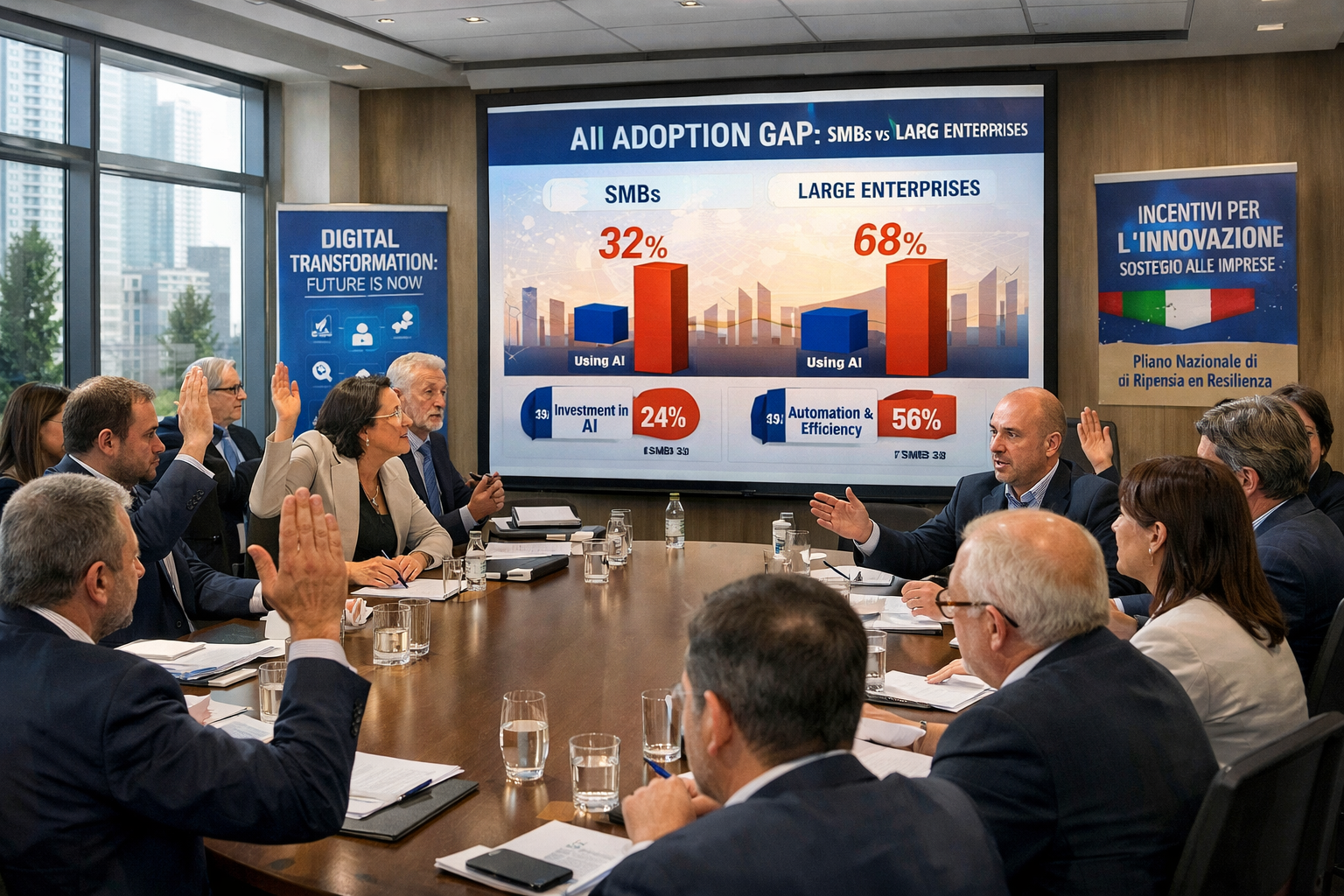
Italy's AI market grew 58% in 2024. The share of Italian SMBs that have actually started an AI project sits at 15% for mid-sized companies ...